Showing posts with label Parenting. Show all posts

20 May 2026

Teaching vs. raising children

 The idea that schools should ONLY teach, as if nurturing children is separable from teaching, contradicts both common sense and the legal principle of in loco parentis.

It is common sense that anybody that takes custody of a child is responsible for that child’s well-being. No reasonable parent would give their child to a teacher that recklessly starved, suffocated, or dehydrated students. Nor should they send their children to a teacher that routinely alienated, controlled, and frustrated the skills of their students. All human have primary psychological needs for relatedness, autonomy, and competence which are just as important to well-being as the other more well-known needs. I take nurturing to mean, at minimum, the support of primary human needs. It is common sense that anyone who takes custody of a child has a duty to ensure that their psychological needs are supported. Independent of anything else they may be obligated or committed to accomplishing with that child this is the minimum of care that Is owed to the child. 

This common sense view was put into common law through a principle called in loco parentis. The following series of quotes, mostly from legal decisions, will help illuminate the principle. 

In Sir William Blackstone's compilation of English law from 1770 he made it clear that the “exercise of power [by a tutor or school master] is limited to what is ‘necessary to answer the purposes for which he is employed.’” (p. 271, Zirkel & Reichner, 1986)

“[T]he courts have accepted with relative ease the notion that in loco parentis gives rise to duties as well as rights of educators.” (p. 281, Zirkel & Reichner, 1986) 

“The status of a parent, with some of the parent's privileges, is given a school teacher by law in aid of the education and training of the child…” (Guerrierri v. Tyson, 1942)

Blackstone assigned three duties to parents that are “transfer[ed] to teachers: maintenance, protection, and education.” (Worley, 2003)

“We are not here concerned with the law applicable to punishment of a pupil by a teacher; but rather with the law applicable to the duties of a teacher in the care and custody of a pupil. In the faithful discharge of such duties the teacher is bound to use reasonable care….” (Gaincott v. Davis, 1937)


There are a variety of ways that a school institution cannot act like a parent and the law carves out limitations and deviations accordingly. But the foundational principle of in loco parentis is that parents are responsible for ensuring the well-being of their child AND when they entrust their child to school personnel, that makes those school folks into caregivers who are likewise obligated to support the child’s well-being. 


Marco Rubio’s comment quoted in the meme demonstrates his ignorance of the principle of in loco parentis, ignorance of children’s needs, and/or a reckless impulse that will harm school children.


19 August 2020

Abusive Isolation is a Problem, not Homeschooling: Responding to Bartholet's Proposed Ban

To hear Elizabeth Bartholet tell it, children in homeschooling families are in immanent peril. The Arizona Law Review published an article by Bartholet entitled “Homeschooling: Parent Rights Absolutism vs. Child Rights To Education & Protection.” She paints a picture of grave danger for children who are homeschooled which leads her to propose “a presumptive ban on homeschooling.” I agree with Bartholet that children have rights to protection and education that may need to be bolstered by both constitutional acknowledgment and some form of enforcement that would probably impinge on the perceived prerogatives of ideologically radical parents. I disagree with Bartholet's conceptions of education and schooling because they mislead the author to conclusions that are not going to ultimately serve the proper end of education, even if they might marginally improve the situation with regards to protection. 


To enable us to get traction on this issue let's consider an analogous situation of protection. Lightning strikes are a potential danger. How much of the freedom of our children and our budget should be devoted to protecting against this danger? We do not routinely dress children in chain mail Faraday suits that would safely channel a lightning strike around their bodies into the ground because such things are both expensive and everyday use would curtail a child's freedom to learn effectively about the world. In fact, no precautions are taken to protect children against lightning on an everyday basis in any family or school that I know about. Lightning strikes are so rare that taking such precautions would be simply ridiculous. Even when there is stormy weather no one routinely takes the precaution of wearing a Faraday suit. Faraday suits are only routinely worn by workers who handle high voltage power lines on a daily basis and performance artists who routinely use high voltage Tesla coils. 


I suspect that Bartholet's fears are stoked by an unreasonable assessment of how isolated homeschooled children are on a routine basis and by an unreasonable assessment of how likely it is that a homeschooling family could become a harmful situation for a child. Bartholet admits she does not have the data to prove it but she nonetheless tells a story suggesting that a significant portion of homeschooled children are endangered by the possibility of a lightning strike of child abuse and that this grave situation warrants dressing every child in the regulatory equivalent of a chainmail Faraday suit. But before I more carefully construct this analogy there are a few points to be made first. 


Both “sides” of this issue are wrong in some important ways. Human nature, as established by the primary human needs empirically established within the Self-Determination Theory community, contradicts both sides. The primary psychological needs for autonomy, competence, and relatedness and their role in engagement with learning activities imply that the ideological notions of how to educate children promoted by the parent's rights absolutists are contradicted by human nature. Those same needs also imply that school practices used to educate children in the majority of schools are also contradicted by human nature. Therefore, the promotion of schools as the standard to which parents must measure up in order to homeschool is misguided. 


What those two “educational” contexts erroneously share in common all to often is an over-emphasis on obedience. Being merely obedient to the dictates of adults, no matter whether they are parents or teachers, is not going to result in a child becoming educated. What will result in an educated child is consistent exposure to an environment in which their primary human needs are satisfied. The two “educational” contexts that are discussed in the article have mostly been places in which the primary human psychological needs for autonomy, competence, and relatedness are not recognized, thus are not meaningfully addressed as central features of the educational enterprise. This particular problem is an inadvertent consequence of simply not realizing that these specific features of human nature exist and how crucial they are to educating children.


A more empirically responsible conception of learning is needed in order to better understand the nature of education and the possible role that both parents and states can play. I favor the inclusion of all types of organizations that serve children in the solving of the problem of ensuring that all children are educated properly. I also accept that it is in everyone's best interests for children to have routine exposure to mandatory reporters as a protection against abuse. 


To be clear, the state’s interest is not in schooling, per se. The state’s interest lies in having a citizenry that is actively empowered to learn without restricting each citizen's view of what phenomena within their environment is worth learning more about. Every citizen of a state is an embodiment of that state. A state literally cannot exist without citizens that can each serve as its embodiment. The state is going to be the best it can be when each and every one of its citizens can perceive accurately, think clearly, and act effectively on self-selected goals and aspirations that are appropriate to their situation. If there are obstructions that impair or distort a citizen’s view of the situation in which they exist, they will fail to accurately perceive, clearly think about, effectively act on, and formulate appropriate goals and aspirations within the situation they occupy. Obstructions can include ideological commitments, community norms, individual physiological or psychological imbalances, and a variety of other mechanisms that exist both within and beyond an individual person. 


Schooling is a formal institutional structure for facilitating learning. Learning is inherently about mapping the reality of the situation in which a person is located such that they can assess the nature of their circumstances and formulate appropriate goals and aspirations. Their goals and aspirations should serve both them, as an individual, and simultaneously the organizations and the society within which they are embedded. There are inherent problems that will inevitably arise whenever the interests of one person or group of people become mutually exclusive with another person or group of people. If a family exclusively serves the needs of children at the expense of parents, then that is just as problematic as the family exclusively serving the needs of parents at the expense of children, states over parents, states over children, parents over states, or children over states. 


These issues could be resolved if objective assessments of the well-being of each actor in the drama could be attained. This requires two or more institutions that can be trusted to make objective observations of the state of each actor (where our interest currently is children). Since we can never fully trust any institution to always and forever act in the best interests of all its members we need redundancy in the over all system. The idea of designating mandatory reporters is how the state has created this necessary redundancy. 


Bartholet's conception of homeschooling families that can so thoroughly isolate their children from mandatory reporters is an extreme situation. There is no question that it can happen. But there is a question about how frequently it happens. Do we have the resources and the political will to prevent every single instance of child abuse at all costs to our freedoms and budgets? Do we have the callousness to take the parent's rights absolutist position that no child is worth compromising each parent's freedom? Naturally, the answer lies somewhere in between. 


Advocates for investing in protection regimes need to prove that the danger is preventable by the means they propose. Contrary to the impression that Bartholet creates, the limited research on homeschooling and my experience with homeschooling families suggests that the vast majority of families expose their children to mandatory reporters in a variety of non-school contexts such as 4-H, scouting, classes, medical appointments, sporting activities, etc. I suspect that Bartholet's proposed ban would complicate the lives of millions of children without providing any additional societal benefit simply because those families most affected by her plan already expose their children to mandatory reporters on a regular basis. The people Bartholet imagines might be exposed as abusers are the very people who are most unlikely to comply in the first place. Regardless of their choice of schooling option the abusers are isolating their children from others and that is the central problem to be solved. That problem is not substantively addressed by banning homeschooling.


What is needed is objective, trustworthy measures of the psychological conditions that children experience in any educational environment that they encounter, regardless of whether the responsible institution is the family, a school, or some other organization. Since we know that certain psychological conditions lead to better learning, then we know that any environment that consistently provides those conditions is providing the basis for an optimally educational environment (note: merely the basis, not the full extent). One of the central conditions for that kind of environment is relatedness. Parents who are controlling their children so thoroughly as to isolate them from mandatory reporters are, at minimum, likely to be thwarting their child's needs for autonomy and relatedness. But abusive levels of isolation can be achieved even while sending a child to school due to the problematic ways that too many schools can also ignore the autonomy and relatedness needs of children. When schools are more focused on getting obedience rather than engagement from their students then they are just as complicit in the psychological neglect of that child as an isolating parent. 


As an education researcher and advocate who has directly interacted with homeschooling families I assume my assessment of the situation of homeschooling is better than Bartholet's. Her misguided assessment of the dangers posed by homeschooling leads her to faulty conclusions about how plausible it is that homeschooling will lead to abuse that escapes the attention of mandatory reporters. However, even if the danger were real, her proposed remedy would not solve the problem, except only marginally, because it fails to address the central issue of children being isolated by their parents, which can be accomplished independent of their schooling choices. 


05 September 2018

The Start Anywhere, Learn Everything Free Home School Curriculum

The most frequent question about home school curriculum is, "What curriculum should I use?" 

This is a great question, except when it really means, "What units of knowledge, skill and information should I be delivering to my child?" 
Reducing education to "units" to be delivered is extremely common and perfectly natural given how the concept of education is mostly used in our society. 
Unfortunately that concept is wrong which you can read about on my definition of education page.
Educational reform would be far more effective and the necessity of home schooling would be avoided for most people if policies could be written from a more accurate conception. 

That misguided assumption that the particular "units" that are presented to children are the basic "elements" of elementary school or the "primary" lesson in primary school leads to problems, the most widespread of which is the problem of fauxchievement
Fauxchievement is when a student goes through the motions without mastering the material. 
You can avoid that problem by switching what you take to be "primary" or the "elements" that are necessary for your children.

The three primary elements that form the most basic foundation upon which all schooling is built are:
  1. How to manage our own and other people's behavior for the common good a.k.a. governance, politics, and/or power, 
  2. What and how we exchange with others to meet our needs (in the classroom that usually includes attention, papers, grades, test scores, etc. while in the "real world" it refers to time, money, attention, goods, services, etc.), and 
  3. The quality of consciousness that results from living within those governance structures and exchange processes. 
Curriculum is not merely the units of knowledge, skill and information, it is the entire way of living that is demanded by the environment in which the student is immersed. For my in-depth exploration of the concept of curriculum click here. 

3R's Free Home School Curriculum

This changes the nature of the question of what home school curriculum to use considerably.
In this way of thinking the essentials of education boil down to the 3R's: Respect, Responsibility, and Resourcefulness.

My assumption about human nature is that we are state of mind optimizers. 
Everything we do is predicated on the assumption that by doing whatever it is that we are choosing to do in each moment it is an attempt to establish and/or maintain optimal states of mind. 


The REAL Home School Curriculum Concern
But there is a very important concern that is behind the original question about what home school curriculum to use. 
That concern is for the future of your child; "How will I know that I have done everything that I could do to ensure that s/he is going to succeed?"


John Dewey addressed this concern very well back in 1938 in his book Experience and Education
"We always live at the time we live and not at some other time, and only by extracting at each present time the full meaning of each present experience are we prepared for doing the same thing in the future. This is the only preparation which in the long run amounts to anything."

Today even more than in Dewey's time we cannot know what the future holds. 
Even though we may think we know what knowledge, skills, and information our kids will need in the future, we will get the details wrong. 
The thing that all life forms, including our children, continue to need and will always need no matter what occurs in the future is access to optimal states of mind. 
The Start Anywhere, Learn Everything Home School Curriculum is a practice of cognitive cartography that has both teachers and students mapping access to optimal states of mind. For a full explanation of why the cognitive cartography definition of education is better than the delivery definition in a home school curriculum click here.
It really doesn't matter what knowledge, skills, and information are used, as long as the basic practices are focused on the 3R's and solving problems and achieving goals.

The 3 Basic Free Home School Curriculum Practices
The three basic practices in the Start Anywhere, Learn Everything Home School Curriculum are; 
  • empathy, 
  • planning, and 
  • decision making.

Each of these practices is required of both teachers and students.
It is presumed that the teachers start off more accomplished at each of these practices than students but that the teachers are committed to a gradual process of relinquishing their role in planning and decision making for the students in order to give the students ever more responsibility for their own activities. 
Teachers are always ultimately responsible for their own behavior and the maintenance of respect and safety within the group. 
This means that teachers are responsible for the context of the relationships between teachers and students, but not necessarily doing "educational" activities in that context.


The practice of empathy is required in order to know your own mind and the minds of others. 
Minds are not truly separated from bodies nor from the world in which they are embedded, despite our illusory perceptions to the contrary. 
Thus the more you know of the minds of others, the more you know about the influences that are affecting your own mind. Empathy is at the heart of both respect and responsibility.

The practice of planning is required in order to develop greater skill at anticipating the long term success of your problem solving and progress towards your goals and aspirations. 
The essence of planning is the anticipation of what will happen as a result of your own actions. 
Planning is also the process of making predictions about the world and then following up on them to find out whether your predictions are effective or not. 
Planning is at the heart of both responsibility and resourcefulness.

The practice of decision making is required in order to balance your needs with the needs of the other people who are being affected by your decisions. 
Decision making is at the heart of both resourcefulness and respect.

The 3 Basic Free Home School Curriculum Principles
You might have noticed that the three practices and the three principles are intimately intertwined. 
Respect is the combination of decision making and empathy. 
Responsibility is the combination of empathy and planning. 
Resourcefulness is the combination of planning and decision making. 
Each of the principles is a delicate balancing act.

Home School Curriculum Principle #1
As the adult you are charged with the ultimate duty to maintain safety and respect.
If you wield your decision making power as the adult without practicing empathy for those over whom you exercise your power, then you will not be respectful. 
If, on the other hand, you are so empathetic about your children's aversion to conflict and difficult feelings that you cannot make hard decisions that will keep them safe from their own inexperience, ignorance, weakness or vulnerability, then you are also being disrespectful. 
Respect is essentially the willingness to look again (re- again, spect- to see) at your judgment of a situation to make sure you have found the right balance between empathy and decision making.

One of the most common mistakes in education is planning without empathy, which results in adults demanding that children jump through meaningless hoops. 
This irresponsibility takes the form of stupid make-work school assignments or can take the form of a child blindly following their parents goals for them without regard for their own intrinsic motivations and personal aspirations. 
Planning without empathy is most often perpetrated by very well meaning adults who have learned hard lessons in life and want to save child(ren) from the hardships they experienced. 
The problem is when they project the details of how they navigated along their path through life onto a child who is living in an entirely different world, along a totally different path. 
Empathy is the key to preventing this problem. 
Empathy helps you; 
  • keep in touch with your child, 
  • develop the kind of relationship in which you respect each other's unique challenges, and, 
  • figure out how to communicate the most valuable lessons of your life in a way that honors both yours and your child's struggles and triumphs.

Home School Curriculum Principle #2
Responsibility is the ability to respond creatively rather than merely reacting impulsively to situations in your life, it calls for both planning for the future and having empathy for those who will be affected.
Children cannot learn responsibility unless the have support for their primary human need for autonomy. 
Cultivating the 3R's in children requires parents to provide more autonomy support and become less controlling.

Home School Curriculum Principle #3
Resourcefulness seems to be generally denied in children's lives today. 
As we have come to perceive the world as being more dangerous we are increasingly protecting our children and cutting them off from the opportunities to make a lot of decisions. In order to become good at a skill you have practice. 
Decision making is one of the most important skills in life and children need all the practice they can get. But once again, there is a balance to maintain. 
Planning is also necessary to achieve anything complex, therefore there is a discrepancy between your more comprehensive adult vision of what is possible in their lives given the right early training and their need for the feedback of making decisions themselves. 
Resourcefulness is about being full of the source again; it's about being the creator of your life. 
The most important key to being resourceful is ensuring that you and your children build on strong foundations of respect and responsibility as you create your lives together. 

Your Free Home School Curriculum Agenda
One of the main differences between me, as a private teacher, and you as a parent, is that you probably have more goals and expectations of your children than I do. 
Do yourself a favor and discuss your goals and expectations with your children. 
If you have an academic agenda then you would be wise to help your child understand the moral foundation of your agenda so that they will understand why they have to do the things that you will make them do. 
Share with them how and why your agenda for them expresses your values. 
And also respect their goals and aspirations, too. 
Make your agenda the start of a conversation, not the basis for imposing control over their behavior. 

I do not have an academic agenda for kids (although I expect excellence if they choose to pursue academic goals), therefore I have no inclination to impose academic instruction. 
Part of the reason I do not bother with an academic agenda is because I know that academics are a huge well of resources for achieving goals and solving problems. 
Therefore, if I keep insisting that the kids pursue goals and solve problems they will inevitably discover that they need academic skills to succeed. There is no avoiding it in the society I live in. 

(It would, of course, be very different if I lived in a different society and was a different kind of person. 
If you expect your kids to learn things that you don't know, then you will have to send them away to people and into communities that know and teach whatever you want them to learn. 
If my students need more than I can give them then my job becomes facilitating their process of finding the right catalysts for their learning and supporting them to be successful.)

My Home School Curriculum Practice
What I did when I was a private teacher home schooling other people's kids was to have a contract with every one of my students. 
The contract spelled out how we were going to be operating as a consensus run small group according to the 3 R's. 
We were each to be responsible for our own behavior while I, as the teacher, would have the power and additional responsibility for maintaining safety and respect.

Once the contract was in place then I asked the kids, "What do you want to do?" 
And then I waited for answers, real answers, not evasions. 
They always evaded at first, "I don't know." Or, "What do you want to do?" 
If I answered at all I would usually answer with something along the lines of, "I want to find out what we can do to have fun instead of sitting around here all day. What are some of the things you like to do?" 
Once they started making suggestions I accepted everything as a possibility, no matter how absurd or uninteresting to me personally.

After we had at least a few potentially interesting ideas that I would be willing to pursue, then I would have them choose the one they think would be the most fun. 
Then I helped them think about what might actually be possible given our limitations of budget, timing, physical reality, our agreement on consensus decision-making, and stuff like that. 
If flying to the moon struck us as the most potential fun, then there are obvious things that will prevent us from accomplishing that right away. 
We would try to figure out the most potential fun until we got to something that we all agreed was both fun and possible. 
If it was something that could be done right then, we did it. 
If not we figured out what needed to happen next and if we could do that right then, we did it. 
If not we continue until we figure out what we could do right then. 

The outcome of this process was often a combination of some goals and some problem solving. 
We also got to know each other based on what we think is fun and the limitations that we shared. 
Often times, since I was working with 6-12 year olds, there were things that they do not know how to do and part of our process together was helping them to develop the skills they needed to accomplish their goals and solve their problems. 
I was not there to entertain them, protect them from the adversity of challenges, nor to provide them with everything they wanted.
My job was to help them discover more and better ways to be fully engaged with living life respectfully, responsibly and resourcefully.
That's all there was to it.

That's ultimately all there is to do in this world, anyway, as far as I am concerned. 
When problems arise we solve them. When goals inspire us we pursue them. 
When there is a lull in our time then we might get bored. 
That' O.K., as long as we meet the expectations of being respectful, responsible and resourceful, too. 
If it becomes a problem, then we solve it. 
If we really hate being bored then we can set a goal to avoid it.

27 July 2018

Parenting Advice: Absurd or True?

Can we trust expert parenting advice?

What's a parent to do when parenting experts disagree?

Take these two statements from Psychology professors at the highly respected universities of MIT and Harvard.

    "[P]arents don't matter. What matters, other than genes, is a child's peer group."

         MIT Professor of Psychology, Steven Pinker

    "[T]here is ample evidence that, for better or worse, parents do shape their children."

        Harvard Professor of Psychology, Jerome Kagan

What's going on here?

And how is it even possible to seriously propose the idea that parents don't matter?


The Pinker quote is from his introduction to Judith Rich Harris’ book The Nurture Assumption, which makes a very convincing case against important parts of the expert parenting advice of recent times.

Conventional wisdom would have us all believe that parents can cause children irreparable lifelong psychological harm if they do the wrong things and can convey significant advantage if they do all the right ones.


A Closer Look at Expert Parenting Advice


But is it true?

That's what scientists like Pinker and Kagan have been trying to puzzle out for decades.

They have amassed a lot of data to work with.

And herein lies the problem.

There are great volumes of data and Harris turned a skeptical eye to the data.

She made a careful reclassification of the existing studies and found that a lot of it was effectively useless.


Let me explain.

Let's pretend we have a collection of this kind of data on a bunch of normal kids.

Notice that this will not tell us about abuse or neglect because those are not normal and all the studies have gathered their data this way.

And what we would find is that they are distributed in a couple of interesting ways.


The Two Dimensions of Children's Data 

First the kids have varying levels of affection which ranges from being warm to cool, and second they vary according to how impulsive they are which ranges from assertive to reserved.

Now what we also find is that if we tilt our scales a little then the altitude becomes a pretty reliable predictor of later success in life.

Adding the Third Predictive Dimension to Children's Data

This predicts that someone who is both warm and assertive is the most successful kind of person while someone who is assertive but rather cold will do better than someone who is warm but reserved.

(If you have read my parenting styles page then this will look familiar.)

Finally, of course, if someone is both cold and reserved, then they are the least successful.


Dissecting Expert Parenting Advice


So the important question is what caused them to be that way?

Is it in their inherent, inborn nature or is it how they have been nurtured?

Is it hereditary or is it the environment?

Expert parenting advice is bought and sold in vast quantities on the assumption that the family environment is the most important factor.

Before I go on I have to point out that this data is NOT about the whole child, it is only about the measurable qualities of intelligence and personality that psychological tests and observations can record.

So there are two things to that are very important to notice:

First, this is data about a narrow part of what normal people are like, it does not reflect everything about what we may really think makes people who they are.
Second, it is data that is analyzed in a population. It is not about individuals, it is about a group.
Scientists have been puzzling out the differences between genes and learning for years and found that they cannot make any headway looking at individuals.


What Harris did that was remarkable was she used the data to show that heredity is more important that it was assumed to be and she also called into question who it is that is doing the nurturing.

So now, instead of just looking for the effects of just genes versus the environment, we are looking for the effects of genes versus the family environment versus the non-family environment.

They are normally called the shared vs. the unique environment.

Unique or shared in the sense of what is unique or shared within a family unit because that was assumed to be the most important factor.

And what this data makes available is NOT an accounting of which of the causes put someone in a particular place in the data set, it tells us how much each of the three causes contributes to the variance in the population.

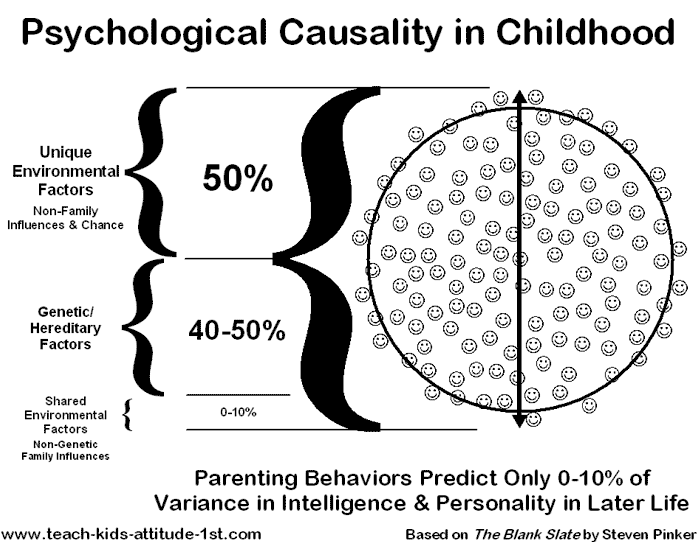
So what we have in the whole data set is 100% of the variance.

Three Causal Factors in Children's Data

Then, when the data is analyzed properly the data shows that the unique environment accounts for 50% of the variance.

What that means is that if I was somehow miraculously able to know exactly how genes and your family determined your position in the set, then we would know that your actual position is going to be somewhere within a circle this big.

1st 50% of Causal Influence on Children is Unique Experiences & Chance

As you can see we can make only a limited prediction about future prospects.

Essentially, what this shows is that when they have examined the personalities and intelligence of identical twins they vary this much and no more because of the unique experiences that they each have.

That’s a lot of room to move.

Now if somehow I was able to determine exactly how unique experiences and genes determined your position but still did not have a handle on the shared family environment which is essentially the effect of parenting behaviors, then how much variance is there going to be?

The data show that the shared environment accounts for zero to ten percent of the variance depending on which studies are used.

Psychological Causation in Children (0-10% is Parental Behavior)
This is what is meant when someone giving expert parenting advice says that parents don't make a difference.


The Truth Behind Expert Parenting Advice


They mean that when you try to predict the intelligence and personalities of whole populations by observing parenting practices you don’t get good predictions.

As long as you are looking at normal kids, then it doesn’t matter what the parents are doing (within the normal range), the children's success in adult life will be a result of a combination of genetic endowment, their unique experiences and the chance events that occur to them.


Harris work is directed primarily at researchers to make the very important point that if they don’t give heredity it’s due and forget that a child's environment extends beyond the family then their data is bad, their analysis will be useless and the resulting expert parenting advice will be worthless, or even worse it might put an unnecessary guilt trip on parents for not being good enough.


Beware of Expert Parenting Advice in Sound Bites


So the controversy is really a red herring.

No one has actually suggested that parents don't matter AT ALL, they have only said that parenting behaviors don't influence the success that a child will attain as an adult due to his or her intelligence and personality.

No matter what you do directly to your child as a normal parent you cannot permanently change your child’s intelligence nor their personality,despite what some expert parenting advice will say.

So while Steven Pinker’s controversial statement was based on the truth, the combination of taking it out of context and his overstating the case makes it an absurdly provocative sound bite.


Redeeming Pinker's Expert Parenting Advice


And, therefore, Jerome Kagan's statement is perfectly true, as well.

In fairness I will let Steven Pinker redeem himself with this excerpt from his book The Blank Slate:

"Not everyone is ... accepting of fate, or of the other forces beyond a parent's control, like genes and peers.

'I hope to God this isn't true,' one mother said in the Chicago Tribune.

'The thought that all this love that I’m pouring into him counts for nothing is too terrible to contemplate.'

As with other discoveries about human nature, people hope to God it isn’'t true.


"[Remember]… a parent and a child have a human relationship.

No one ever asks, 'So you’re saying it doesn't matter how I treat my husband or wife?' even though no one but a newlywed believes that one can change the personality of one's spouse.

Husbands and wives are nice to each other (or should be) not to pound the other’s personality into a desired shape but to build a deep and satisfying relationship.

Imagine [you] told [me] that [I] cannot revamp the personality of [my] wife and [I] replied, 'The thought that all this love I'm pouring into … her counts for nothing is too terrible to contemplate.'

So it is with parents and children: one person’s behavior toward another has consequences for the quality of the relationship between them.


"Yes, it is disappointing that there is no algorithm for growing a happy and successful child.

But would we really want to specify the traits of our children in advance.…

People are appalled by human cloning and it's dubious promise that parents can design their children by genetic engineering.

But how different is that from the fantasy that parents can design their children by how they bring them up?

Realistic parents would be less anxious parents.

They could enjoy their time with their children rather than constantly trying to stimulate them, socialize them, and improve their characters.


"[These insights into parenting are] rescuing mothers from the fatuous theories that blame them for every misfortune that befalls their children, and from the censorious know-it-alls who make them feel like ogres if they slip out of the house to work or skip a reading of Goodnight Moon.

And the theory assigns us all a collective responsibility for the health of the neighborhoods and culture in which peer groups are embedded.


"Parents wield enormous power over their children, and their actions can make a big difference to their happiness.

Childrearing is above all an ethical responsibility.

It is not OK for parents to beat, humiliate, deprive, or neglect their children, because those are awful things for a big strong person to do to a small helpless one.

As Harris writes, 'We may not hold their tomorrows in our hands but we surely hold their todays, and we have the power to make their todays very miserable.'"


Professor Pinker and Judith Rich Harris have both looked deeply at the data and helped to illuminate what we all knew deep down to be true from the beginning.

Our moral responsibility begins with compassion.

Regardless of what expert parenting advice you get, your first and foremost duty in this life is to attend to the well-being of your family.

Neither you nor your children will thrive for very long in the community if you can’t first manage to get along within your family.


Discerning Good Expert Parenting Advice


Here are ways that parents do make a difference:

  • Parents protect their children from abuse and neglect that might cause permanent psychological harm.
  • Parents are responsible for what children learn about how to be in a family.
  • Most importantly parents have an inherently intimate relationship with their children, therefore they have a unique opportunity to be a strong presence in their children’s lives.


So it is absurd to say that parents don't matter.

But expert parenting advice for improving your child's intelligence or personality is also a waste of time and money.

In the end the most important parenting investment is creating the best possible relationship with your kids.

Not to be different than you are; not to make them different than they are; but to acknowledge and honor that you are each doing the best you can do with what you got, even when it's not perfect.

26 July 2018

Parenting Styles or Childing Styles? Who causes what?

The way parenting styles are typically presented would have you believe that parenting is a behavioral challenge that contradicts the fact that parenting is a moral, not behavioral, challenge.

The researchers claim that if you behave the right way as a parent then everything will be O.K. for your child.

This is wrong (except for the obvious deleterious effects of abuse, which is excluded from parenting styles research.)


Parenting is a highly volatile topic that must be handled with extreme care.

The passion of people’s reactions to questioning parenting styles are just below the nukes of religion and politics in explosive potential.

So, I hope you will forgive my taking you through a three point detour before addressing the topic of parenting styles fully.


Detour #1: Human Bias


First, let’s talk about you.

You, I am assuming, are a human being.

That means that you and I have a lot in common.

There are lots of things that are very different, but in a large number of important ways we are practically the same.

We both have remarkably similar brains that have been structured to remember certain kinds of things better than others.

Your brain, like mine, is thoroughly biased.

As a society we have tried very hard to modify those biases to be more fair to everyone, but we all have bias none the less.


In particular we are biased to remember personal relationships and interpersonal dynamics better than impersonal relationships or group dynamics.

This is a bias that makes it very difficult (probably impossible) for each of us to individually account for many of the causal influences that shape our lives.

We are incapable of perceiving the influence of genetics, social norms, or group-to-group interactions on our personal lives.


Detour #2: Human Nature: Nice and Demanding


Second I am going to make some assertions about human nature and how we, humans, react to other humans based on how demanding and how nice the other person is.


  • We give more to people who demand more.
  • We treat people better when they are nice to us.
  • Put them together and consider the extremes:


If someone is nice to us AND demands more they would get the most of all,
Someone who is neither nice NOR demanding would get the least,
Of those who are either ONLY demanding or ONLY nice, then the person who just demands more would get more than the person who is just nice.
I expect that you will not have any problem with these generalizations, except maybe that they are generalizations.

The truth is that most people are in the middle of the array with varying degrees of demandingness and niceness from day-to-day.

This is entirely based on the expectations of normalcy, without accounting for extremes of abuse nor insanity.


Detour #3: Anti-Intuitive Science


Third, the inherent bias of our minds is the key reason that we had to develop science as a method of getting a more reliable handle on how the real world actually works.

By creating a systematic method for making valid observations and having an on-going cultural conversation to analyze how those observations are best woven together into theories that explain cause and effect we have given ourselves powerful tools for understanding the world.


What is interesting is that science appears to be a consistently anti-intuitive influence.

By anti-intuitive I mean that science has repeatedly exposed our intuitive thinking about the world to be largely inaccurate, even if it was close enough to get by in ages past.

Given the bias I mentioned in the first point of this detour, we do not normally think using scientific ideas, like genetics, unless we have a lot of training or other powerful experiences to change our thinking.


The point of this final diversion is that just because science is anti-intuitive, that does not mean we should simply reject intuitive ideas.

Science has to not only refute an intuitive idea it has to provide both a logical basis for rejecting it and also provide another more logical way of thinking about the phenomena in question to replace the old intuition (even though it will be very difficult to get people to think that way.).


Consider this budding scientist's story:

One day I noticed that every time I woke up in the morning with my shoes on I also had a splitting headache.

So I decided to investigate further and asked my friends and neighbors if they experienced the same thing.

Amazingly, they all said that the same thing happened to them, too.

(Although a few of the people I talked with did not have the experience of waking up with their shoes on.)

So I decided to do a controlled study of this interesting phenomena.


I designed a longitudinal study with thousands of people across the country.

When the data came back my analysis showed the not only was there a very strong correlation between waking up with your shoes on and having a headache, but also a significant correlation with staying up late, too.

When I released the study some reporters interviewed me and wrote terrific stories about the hazards of wearing shoes to bed after staying up late at night.

The Times reported that removing your shoes before bed might be a good way to prevent headaches.

In a follow-up to the study I also showed that there was a genetic link to both staying up late and going to bed with your shoes on.

Further analysis of the data showed a strong genetic influence.


Do you see any problems with this study, the conclusions that were drawn or the reporting of the results? Can you think of a better explanation?


Consider an alternative that might be a better causal explanation for the key correlations; the shoes, the headache, and the genetic link.

Did it occur to you that consuming alcohol is most often done after normal work hours or at night on the weekends, that excessive alcohol consumption is likely to lead to late nights and that drunk people are more liable to not take their shoes off when they finally get to bed?

Also, that the susceptibility to both excessive drinking and hangover headaches probably have strong genetic components?


The problem with this fantasy study is that it did not properly account for more than one explanation.

One of the keys to good science is the generation of many possible causal explanations and then the systematic elimination of or accounting for different possibilities.

The point is that noticing the correlation between two phenomena is not enough to establish that one causes the other.

In order to truly establish a simple causal relationship the scientist must eliminate the following three possibilities that;


  • there are any other causes,
  • the relationship is so complex that the correlation is merely coincidence, or
  • that supposed “effect” is actually causing the “cause” in a self-reinforcing system.


Parenting Styles

Now let’s consider parenting styles.

Remember the bias I mentioned?

We are biased to remember the personal more than the impersonal.

For most people the members of their family are the most prevalent long term relationships in childhood.

Naturally, most people will have more memories of their family than anything else.

This mass of memories will naturally lead them to attribute causal significance to their family.

Naturally, it is easy to speculate that if you were treated differently in childhood, with a different parenting style, then your outcomes in life might have been different.

This is also why the influence of parents is a hot topic; if you have developed a comfortable explanation for how your family affected you then it’s offensive when an outsider tries to meddle with the story of who you are and why.


The research into parenting styles has found a mountain of correlation between parenting behavior and certain long term outcomes for children.


But, they have not accounted for the role of genetic causation, they have not effectively tested the possibility that the children’s peer group might be a significant causal influence, and they have only recently begun to acknowledge (but not actually account for the possibility) that the children might be causing the parents behavior.

These are the charges against the parenting styles research leveled by Judith Rich Harris in her book The Nurture Assumption.


A quick aside on the book The Nurture Assumption: Reporters and reviewers tend to focus on the controversy-provoking idea that “Parents don’t matter.”

That is not what the book is really about, it is just an emotional hook.

As the author takes great pains to point out over and over in the book, parents do matter, but not in the ways they intuitively think they do.

Finally, the book is written in an engaging style but is not really for parents, it’s primary audience is supposed to be parenting researchers.

If you are interested in the details of research, then it’s a good read, but if you are looking for straightforward parenting information, don’t bother.

For an easier read that takes a careful look at parenting with these research results in mind I recommend Where Did THAT Child Come From? by psychologist Dr. David B. Cohen.


The parenting styles research shows a strong correlation between the “parenting” behavior of parents and functional outcomes for kids.

But is the correlation they found the effects of parenting or the effects of childing?

What is more likely is that the “functional outcomes” are a reflection of how our society has rewarded children with those particular characteristics.

Below is a diagram I made while attempting to understand the parenting styles research findings (before I read the Nurture Assumption and Where Did THAT Child Come From?):


The diagram shows the basic findings of the parenting styles research modeled on Diana Baumrind’s model.

The two dimensions that determine a style are the parent’s level of behavioral expectations and the level of responsiveness of the parents to their child.

I tilted the array to visually reflect the relative “effectiveness” of the different styles from least effective at the bottom to the most effective at the top.


This seemed like a really good way to think about parenting styles.

In fact, I think it still is a good way, but not to understand causal effects.

To say that the parenting behaviors reflected in this research causes particular outcomes for children is not accurate.

When I change the labels of the two dimensions to reflect children’s impulsiveness (which generates an obvious need for an authority who can help protect them from themselves) and their level of affection (which would reflect a tendency to be sociable or nice), then the diagram seems to me to be an equally true explanation of parenting behaviors:


The above diagram reinterpreting the parenting styles research is another way of illustrating the assertions about human nature I made in the second point of my detour at the beginning.

From over 20 years of experience of dealing with kids this second diagram of the results of the research is really proving the common sense notions that we respond to characteristic behaviors in predictable ways.


When I was a camp counselor, my first encounter with being responsible for kids, I actually taught the kids about how to read my expressions to tell whether they would be able to “get away” with stuff.

If I looked distressed then they should expect me to be more authoritarian but if I look relaxed then they could expect me to be more permissive.

I taught them that I was consistent, but not that I would treat them the same way every time.

I would treat them according to my best judgment, which changed according to the situation.

When there was danger, conflict, or some kind of problem I would look stressed and assert more control as a means of protecting them (they were typically 7-12 years old).

When there was no danger I would be relaxed and allow them more freedom.

Childing Style:
Impulsive and Affectionate Child

The kids who had the combination of impulsiveness and personal warmth would be the most successful at influencing circumstance to meet their needs.

They were willing to stick their necks out and had a warm relationship that made it easier for me to trust them.

Childing Style:
Impulsive and Not Affectionate Child

The kids who were comparatively demanding without the trust were just a pain in the ass and they tended to get a lot of my authoritarian attention.

Childing Style:
Not Impulsive and Affectionate Child

The kids who had warm relationships but were not demanding were the easiest because you could trust that they were not going to create any danger for themselves or anyone else so you could let them do anything they wanted (remembering that they never want to do anything dangerous).

Childing Style:
Not Impulsive and Not Affectionate Child

The kids who lacked impulsiveness and lacked a warm relationship were nearly invisible and consequently very easy to overlook given the demands of all the others.

Given the context of the camp environment it would have been extremely unlikely for this to be the case very often.

Despite being in a sizeable group we had lots of time to get to know our kids and ensured that they all had some level of support and positive interaction.


The parenting styles research does provide ample proof of the fact that a diversity of parenting styles (different constellations of parenting behavior) exist and that there is a disparity in outcomes for children, but the research does not prove what causes the differences in outcomes.

There is not clear evidence which behavior; the parent’s, the child’s or both, is responsible for the styles.

It is also unclear whether the behaviors cause the outcomes or some other factors in the psychological, cultural, and social contexts in which both children and their parents are embedded might be more significant as causes than styles of behavior.

Nor does the research provide any evidence that those behavioral patterns can be effectively changed to benefit the children.


The robust findings of parenting styles research can be reinterpreted as evidence the idea that demanding people get more than merely nice people and people who are both nice and demanding get the most.


What can we learn from this?
First, the facts are simple even if the implications are complex.

The simple facts are that parenting is complicated, the biggest factor in a child’s destiny is his/her genes, boldness and compassion are both advantages, and parenting is a moral challenge, not a behavioral one.

The first four are fully supported by the parenting styles research, even if they don’t realize it.


Using the label “parenting styles” is no longer necessary.

They are simply behavioral styles. And our behavioral style, regardless of the role we play, is a factor that we need to be aware of as we evaluate the quality of our relationships.

But, our behavioral styles will change across different situations, so it is of limited value as a reference point.


The real question of ensuring better outcomes for ourselves and our children boils down to three things; how we structure the control of our own and other people’s behavior for the common good, what and how we exchange with each other in order to meet everyone’s legitimate needs, and the patterns of consciousness that result from being embedded in those structures and processes.

Are there ways of organizing our interactions such that everyone is inherently able to be more assertive and compassionate at the same time?

The answer is, Yes!

But that is a long conversation for another page or perhaps a whole book.


There are three key causal variables in the generation of outcomes for people:

Their genes
Their situation, and
How they identify themselves within that situation.
To re-frame parenting styles from this perspective means that their style is not merely a pattern of behaviors but


  • how they teach awareness of and accommodate differences in temperament and disposition (accepting genetic causes),
  • how they encourage practices of empathy, planning and decision-making in the family over time (managing the power structure), and
  • how they influence the range of identities that are available to themselves and their children.

This is what I would consider spiritual parenting, a practice of positively integrating everyone into a family system on a mission to support everyone to be the best person they can be.

Beyond Parenting Styles #1: Here is the Preventive Ounce web site that can help you understand your child's temperament.

Although the Preventive Ounce temperament assessment tool is made for birth to four year olds I recommend it for any age as a great method for reflecting on your child's behavior, no matter how old. If you have a child over 4 just select the oldest category and ignore their predictions in the results.


Beyond Parenting Styles #2: I also recommend Lyndal Schick's book Understanding Temperament as a good introduction to how your behavioral style will interact with your child's behavioral style, for better or worse.

She also includes tips on how to reconcile the conflicts between styles.

25 July 2018

The Five Parenting Facts

Parenting Facts #1: Parenting is a complicated game. 

The job description is actually very simple, but doing the job can be extremely challenging. 
Parenting is, in that sense, like the best games; they are simple to learn and can take a lifetime to master. 

Parenting Facts #2: Genes are a parent's biggest contribution to a child'’s life. 
The child’'s biology determines his/her disposition and disposition determines the limits of some unknown range of opportunities and possibilities that exist throughout the child’s entire life. 

Parenting Facts #3: Assertiveness is an advantage. 
No one knows what limits exist for anyone else (except in general terms like not being able to grow wings or sprout horns) so children who learn perseverance and determination to overcome illusory limits will be at an advantage.

Parenting Facts #4: Compassion is an advantage. 
Everyone knows that limits exist in the world and children who learn to respect people’s beliefs about the world (while overcoming their own limiting beliefs and/or understanding real limits in the world) will be at an advantage.

Parenting Facts #5: Parenting is about moral balance not correct behavior. 
Morality is ultimately about creating well-being. 
Expressing moral values is about enacting strategies to ensure the well-being of yourself and those with whom you identify (as family, friends, co-workers, or by culture, gender, species, planet, etc.) 
The fundamental parenting challenge is balancing the application of your moral values, knowing the real limitations in each situation, and meeting the legitimate needs of everyone involved.

Based on these five facts your job as a parent is to live a moral life and do your best to provide your children with a moral foundation for living theirs. 
Facts 2-5 are more broadly applicable to living and teaching, as well. 
The real questions that need to drive your behavior are: 
  • What are my moral values in this situation? What is the RIGHT thing to do?
  • How do I express my moral values (how do I create long-term well-being for everyone) in this situation?
  • How do I recognize when my behavior contradicts or undermines my moral values?
  • How do I change my behavior to be in better alignment with my moral values?